Choosing between a twin-rod and a standard single-rod actuator depends on the load path, not on the number of rods alone. You will be able to compare guidance, force, space, service life, and machine-cycle requirements before specifying a cylinder or requesting a quotation.
Key takeaways
- Use twin rods for off-centre loads, torque, and rotation control.
- Use a standard cylinder with an external guide for guided linear motion.
- Size force, stroke, load moment, mounting space, and cushioning together.
- Confirm bore, stroke, port thread, rod spacing, seals, and drawings before ordering.
What changes between a twin-rod and standard cylinder?
A twin-rod cylinder controls rotation and handles off-centre moment loads better because two rods and their guide arrangement support the tooling plate. A standard single-rod pneumatic cylinder for automation machines usually needs an external linear guide when the tooling applies side force or torque.
| Option | What changes | Practical consequence |
|---|---|---|
| Twin-rod | Two rods, guide bushings, and added sealing or bearing components | Better anti-rotation and rigidity, but stricter parallel alignment and more installation width |
| Standard single-rod | One rod and one piston-rod guidance point | Smaller footprint and lower purchase cost, but side loads require a separate guide |
| Twin-rod force | Not automatically twice the force | Confirm whether the model has one active piston or two; calculate force from effective piston area |
| Twin-rod maintenance | More guide and seal points | Inspect more components, while a separate anti-rotation guide may be eliminated |
| Standard plus guide | Cylinder supplies thrust; the external guide carries the load | More parts, but often better for heavy, long, or cantilevered tooling |
| Service life | Depends on bearing load, rigidity, alignment, sealing, impact, and cycle rate | Compare published limits and expected wear instead of assuming “twin rod” means stronger |
Choose the twin-rod version when its published radial-load and moment limits cover the tooling and its built-in guidance removes a costly, space-consuming guide. Choose a standard cylinder plus linear guide when the guide already exists, loads are heavy, travel is long, or maintenance access and lower cost matter more.
Neither design replaces proper guidance for substantial bending moments. A twin-rod unit can also need more width and more precise parallel mounting.
Which Bangalore machine applications suit each cylinder type?
Choose a twin-rod cylinder for tooling that must stay square during motion. It suits grippers, short pick-and-place axes, indexing stops, clamps, sliding fixtures, and transfer units carrying a modest off-centre load.
| Cylinder type | Suitable Bangalore application | Selection condition |
|---|---|---|
| Twin-rod | Gripper, pick-and-place slide, indexing stop, clamp, sliding fixture, transfer unit | The tool must resist rotation and the published radial-load and moment limits cover the load |
| Standard single-rod | Straight push, ejector, or centred clamp | An external guide already provides the guide function and the rod sees little side force |
For air cylinder selection in Bangalore, calculate the load centre of gravity and bending moment before relying on the twin-rod bushings. Choose the twin-rod option for anti-rotation; do not assume it provides unlimited side-load capacity or higher speed.
Use a standard cylinder when the load is centred and an external guide is unnecessary. A twin rod cylinder versus standard cylinder for machines in Bangalore is not a choice between “strong” and “weak” units; it is a choice between integrated guidance and guidance provided elsewhere.
Neither type replaces a proper linear guide for a heavy, cantilevered, misaligned, or long-travel load. For high radial load, long unsupported travel, frequent impact, or demanding repeatability, compare a guided actuator, a rodless cylinder with external guide, or a separate linear rail. Check the cylinder’s published limits before ordering.
How do you size the force, stroke, and installation envelope?
Size from the machine cycle and installation envelope, not from bore alone. For a pneumatic cylinder for automation machines, record:
- Required travel, retracted length, extended length, cycle time, payload, acceleration, friction, and available mounting space.
Calculate ideal extension force as pressure multiplied by piston area, then subtract friction and pressure losses before applying a safety margin. A 10 mm bore has about 78.5 mm² area; at 0.5 MPa, one active piston produces about 39 N before losses. Pull force is lower because the rod reduces effective piston area.
| Specification | Airtac TR10X25 | MA20X50SCA |
|---|---|---|
| Bore and stroke | Usually 10 mm bore, 25 mm stroke | 20 mm bore, 50 mm stroke |
| Installation implication | More compact, shorter travel | Larger envelope, longer travel |
| Force comparison | Lower piston area | About four times the bore area before losses |
| Construction | Confirm active-piston arrangement | Verify construction before calling it single-rod |
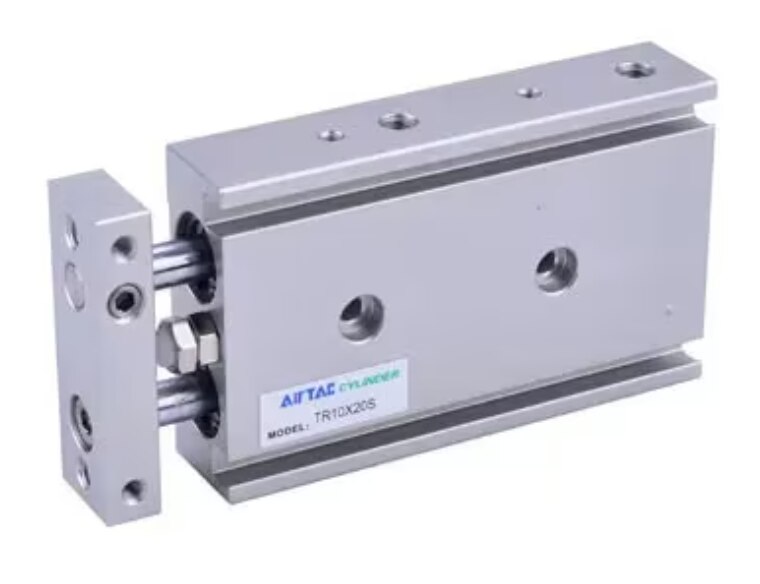
Treat the Airtac TR10X25 cylinder in Bangalore designation as 10 mm bore and 25 mm stroke—not a 25 mm bore or 25 mm retracted length. Confirm that 25 mm covers working travel after cushioning, bumpers, sensor position, tooling clearance, and stops. A twin-rod unit does not automatically produce twice the force.
For a compact station, compare rod spacing, mounting holes, ports, and total width, not catalogue stroke alone. If the load repeatedly meets an external hard stop, include that impact in the guide and actuator calculation rather than treating the nominal stroke as usable travel.
What fit, alignment, and maintenance checks prevent early failure?
For a twin rod cylinder versus standard cylinder decision, check interchangeability before ordering. Match:
- Rod spacing and mounting-hole pattern
- Port size and thread standard
- Sensor groove or switch provision
- Cushioning method
- Operating-pressure range
- Seal temperature range
- Allowable side load and moment
Mount the tooling plate square to both rods. Parallelism errors, a skewed plate, or unequal loading can make the guide bind and shorten bearing life. Move the complete assembly through its full stroke by hand before applying air.
Do not repeatedly use an external hard stop to absorb impact unless the actuator and guide are designed for it. Cushioning, rubber bumpers, sensor position, tooling clearance, and stops can reduce the usable working stroke.
| Symptom | Inspect first | Corrective focus |
|---|---|---|
| Stick-slip or uneven travel | Guide bushings, rod parallelism, tooling load | Realign the plate and remove side loading |
| Leakage | Seals, tube fittings, condensate | Replace damaged parts and improve air preparation |
| Rod scoring | Rod surface, dust, guide wear | Clean contamination and replace worn guides |
| Missed sensing | Sensor position and switch mount | Secure and reset the sensor |
Inspect bushings, rods, seals, fittings, and sensors by cycle count and whenever these symptoms appear. In Bangalore, use a filter-regulator, drain receiver lines, keep tubing clean, and define lubrication intervals and lubricant type. Confirm replacement-seal availability; continuous machines often lose more time waiting for seals than they save through a lower purchase price.
What should you confirm with a twin-rod cylinder supplier in Bangalore?
Ask a twin rod pneumatic cylinder supplier in Bangalore for the exact Airtac series and suffix, not only “TR10X25”. Request the dimensional drawing, mounting pattern, port and thread specification, seal material and temperature limits, permissible radial load and moment, cushioning details, compatible magnetic switches and brackets, batch or manufacturing traceability, and replacement lead time.
A useful quotation should identify the model configuration and every part needed to install, sense, and maintain it:
- Required stroke, retracted envelope, extended envelope, operating pressure, payload, load centre, cycle rate, mounting orientation, and air-quality arrangement.
- Whether the cylinder uses the mounting, port, seal, sensor, and cushioning options shown on the quoted drawing.
- Whether replacement seals, switches, brackets, and complete units are available within the promised lead time.
| Confirmation | Why it matters | What goes wrong if omitted |
|---|---|---|
| Exact series and suffix | Defines interchangeability | A similar code can have different dimensions or seals |
| Port and thread | Matches tubing and fittings | Installation stops or leaks |
| Radial-load and moment limits | Checks the tooling load | Guide wear, binding, or rod damage |
| Cushioning and seal limits | Matches speed and temperature | Impact, leakage, or shortened service life |
| Traceability and lead time | Supports maintenance planning | A failed actuator delays production |
Do not treat an Airtac TR10X25 cylinder in Bangalore as fully specified by TR10X25 alone. Hakimi Pneumatic & Hardware can be considered as a local source, but compare the technical drawing and after-sales availability rather than choosing on the twin-rod label.
Related products
 | Pneumatic Cylinder AIRTAC TR10X25 Twin-Rod Pneumatic Cylinder The AIRTAC TR10X25 twin-rod cylinder is designed for precision and stability in compact automation setups. View product → |
 | Pneumatic Cylinder AIRTAC MA20X50SCA Compact Pneumatic Cylinder – 20mm Bore, 50mm Stroke The AIRTAC MA20X50SCA is a compact pneumatic cylinder designed for smooth, reliable linear motion in industrial automation systems. View product → |
Frequently asked questions
What changes between a twin-rod and standard cylinder?
A twin-rod cylinder uses two rods and a guided tooling plate to resist rotation and handle off-centre moment loads. A standard single-rod cylinder supplies linear thrust but needs an external guide when the tooling creates side force or torque.
Which Bangalore machine applications suit each cylinder type?
Choose a twin-rod cylinder for compact pick-and-place tooling, pressing, clamping, stopper mechanisms, and loads with an offset centre of gravity. Choose a standard cylinder for straight-line pushing or pulling when the load is guided separately.
How do you size cylinder force, stroke, and installation envelope?
Calculate required thrust from load, friction, acceleration, and operating pressure; then check the available bore force at the cylinder's minimum pressure. Match stroke to the actual travel, and reserve space for the body, rods, fittings, sensors, and end cushioning.
What fit, alignment, and maintenance checks prevent early failure?
Align the cylinder with the load, prevent side loading, verify rod spacing and mounting faces, tighten fasteners evenly, and inspect seals, rod surfaces, guides, tubing, and cushioning during maintenance.
What should you confirm with a twin-rod cylinder supplier in Bangalore?
Confirm the exact series, bore, stroke, rod spacing, mounting pattern, port thread, sensor compatibility, seal material, operating pressure, temperature range, CAD drawing, delivery details, and suitability for the machine load.
Keywords