A gripper that accepts the wrong thread or an oversized fitting can leak, restrict airflow, collide with tooling, or damage its port. By checking the HFZ20 interface, matching tube outside diameter, routing the valve circuit correctly, and specifying plant-air conditions, you can order fittings that fit and perform as intended.
Key takeaways
- Confirm the HFZ20 thread standard, port size, location, pressure range, and tube diameter.
- Match push-in fitting shape and tube size to the gripper’s available clearance.
- Connect the FRL, five-port valve, and gripper in the correct pneumatic sequence.
- Specify thread, tube, pressure, material, and quantity before ordering air fittings in Bangalore.
Confirm the HFZ20 Port Before You Order Fittings
Identify the exact HFZ20 model and read its datasheet before selecting pneumatic gripper fittings. Record the port thread standard, thread size, port location, permitted operating-pressure range, and allowed tube outside diameter. “Automation combo gripper” is not a universal ISO product category, so similar jaw dimensions do not prove compatible connections.
| Thread type | Connection characteristic | What to verify |
|---|---|---|
| BSPP/G parallel | Seals with an O-ring, bonded seal, or washer | Port seal and exact G size |
| BSPT/R or Rc tapered | Seals along the tapered thread | Male or female thread designation |
| NPT tapered | Uses a different tapered thread standard | Never substitute for G, R, Rc, or metric threads |
A G1/8–6 mm fitting identifies both the G1/8 pipe-thread side and the 6 mm tube side. Changing the tube outside diameter does not correct an incompatible G, R, Rc, or NPT thread. Forcing NPT into a BSP or metric port can damage the HFZ20 body and still leave a leak.
Add these details to your purchase notes:
- Port faces upward, sideways, or toward the moving fingers.
- Port depth and available wrench clearance.
- Tube outside diameter and material.
- Fitting seal material and operating-pressure rating.
- Clearance from the gripper body, fingers, sensors, and tooling.
This specification matters when comparing air fittings for pneumatic automation combo grippers in bangalore; a fitting that screws in can still leak, restrict air, or collide with the mechanism.
Match Tube Size, Fitting Shape and Clearance
Choose the tube outside diameter from the HFZ20 datasheet, required cycle time, and available routing space—not from the fitting label alone. A push-in fitting marked 4 mm, 6 mm, or 8 mm normally accepts that tube’s outside diameter; it does not state the bore.
Two 6 mm tubes with different wall thicknesses can deliver different flow, so compare effective flow area or rated flow.
| Tube size | Practical use | Check before selecting |
|---|---|---|
| 4 mm | Tight, lightweight routing | Confirm flow supports the required cycle time |
| 6 mm | Balance of flow and space | Compare internal area and fitting flow rating |
| 8 mm | Higher flow for demanding cycles | Confirm the gripper ports and valve accept the larger connection |
For compact pneumatic gripper fittings, check clearance around the gripper body, mounting plate, cylinders, fingers, sensors, and end-of-arm tooling. A straight fitting is simple but may project into the tooling envelope; an elbow reduces collision risk, while a swivel elbow improves orientation at the cost of extra joints and possible vibration.
Use a tee only for a planned branch, and a bulkhead fitting when tubing passes through a plate.
Keep the first bend away from the fitting and follow the tube’s minimum bend radius. A narrow elbow, speed controller, or small tube can restrict gripper air connections even when the supply hose is large. Compare the complete flow path, not just the port or hose.
Connect the FRL, Five-Port Valve and Gripper in the Correct Order
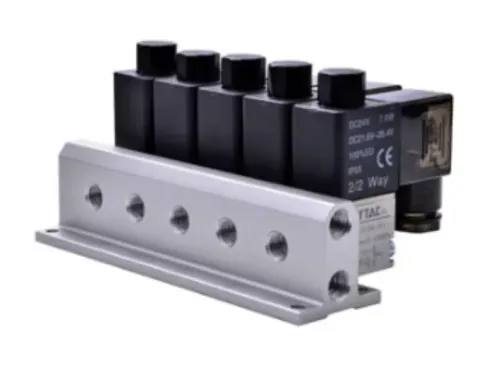
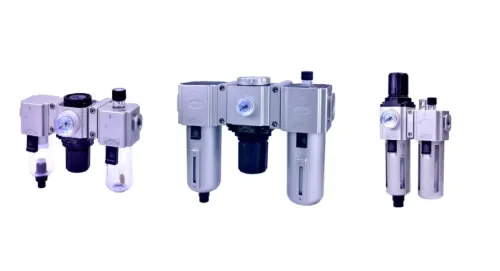
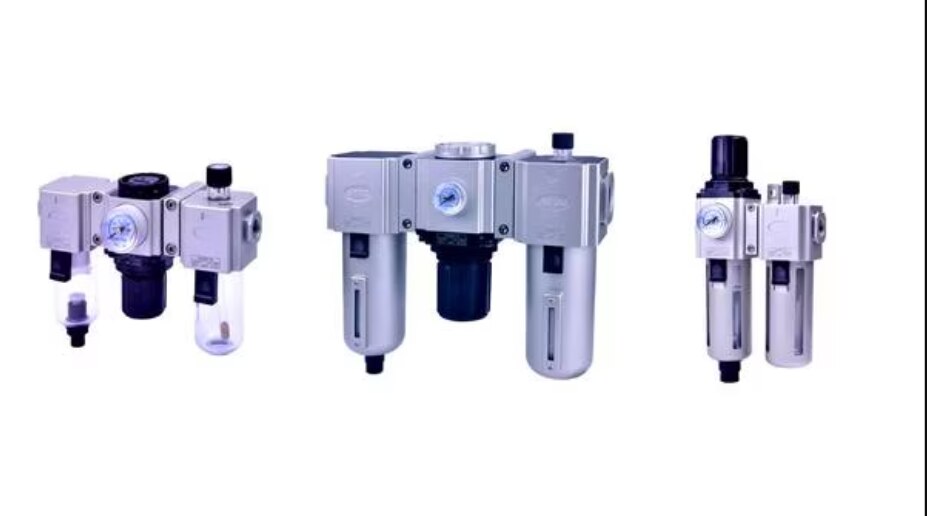
Route prepared plant air through the FRL—particulate filter, water separator, then regulator—before it enters the directional valve. On a standard five-port valve, port 1 is supply, ports 2 and 4 feed the two actuator lines, and ports 3 and 5 exhaust to atmosphere.
Confirm the markings and actuation symbols on the specific valve before making the final gripper air connections.
1. Connect ports 2 and 4 to the HFZ20’s two actuator ports. Test the circuit after pressurising it: one line opens the jaws and the other closes them, so do not assume the direction from port numbering alone.
2. Fit silencers to ports 3 and 5, sized for the valve’s exhaust flow. A clogged or undersized silencer creates backpressure, making opening or closing slow and unequal.
3. Install flow controls in the manufacturer-marked orientation. Meter-out control usually gives steadier motion; excessive exhaust restriction delays jaw movement and reduces cycle rate.
| Control mode | Restrictive element | Practical result |
|---|---|---|
| Meter-out | Exhaust from the actuator | More stable motion |
| Meter-in | Air entering the actuator | Motion becomes more dependent on load and supply pressure |
Cut polyurethane or nylon tube squarely, remove burrs, push it fully to the fitting’s internal stop, and perform a pull check. Use the shortest practical runs; an elbow can clear tooling, but its narrower passage may restrict flow.
Compare the complete circuit’s flow rating because the fitting, valve, silencer, speed controller, or tube—not the automation combo gripper—may be the bottleneck.
Adapt the Fittings to Bangalore Plant-Air Conditions and Safety Needs
A correctly sized fitting fails in service when plant air carries water, particles, oil, or heat beyond its materials. For air fittings in Bangalore, test the compressor and distribution line for condensate, particulate contamination, compressor oil carryover, ambient temperature, and required pressure dew point.
| Condition | Check | Failure prevented |
|---|---|---|
| Condensate | Inspect drains, water separators, and dew-point performance | Corrosion, sticking, and unreliable grip |
| Particles | Verify filtration and replace loaded elements | Blocked passages and valve wear |
| Compressor oil | Check carryover downstream of the compressor | Swollen seals and sensor contamination |
| Heat or chemicals | Compare actual exposure with body and seal ratings | Cracking, softening, or leakage |
Choose fitting bodies and seals for the measured temperature, oil exposure, and cleaning chemicals. Brass, polymer, elastomer, and plated surfaces do not suit every installation. Many modern grippers use non-lubricated air; add oil only when the manufacturer specifies the oil type and application rate.
Match sealant to the thread. Do not put PTFE tape or liquid sealant on a parallel port sealed by an O-ring or washer. For tapered threads, keep sealant away from the first thread and air passage so fragments cannot enter the gripper or valve.
Check the lowest pressure and temperature rating across the gripper, fitting, tube, valve, and operating condition. Leak-test gripper air connections at operating pressure, then inspect joints after repeated cycles. A double-acting gripper does not automatically hold a part after hose rupture, emergency stop, or compressor failure.
If a dropped part creates danger, assess a spring-closed or mechanically locking gripper, check or pilot-operated valves, guarding, and controlled energy isolation.
Write a Complete Purchasing Specification for the Gripper Circuit
Give the supplier a completed circuit specification, not a request for a “gripper fitting.” For air fittings in Bangalore, identify the exact AIRTAC HFZ20 model and copy its port information from the datasheet.
1. State the port thread standard and size, such as G, R, Rc, or NPT, plus the port location: top, side, or toward the fingers. Record the permitted operating-pressure range and the port’s sealing method.
2. State the tube outside diameter, such as 4 mm, 6 mm, or 8 mm, and tube material, such as polyurethane or nylon. Specify straight fittings, elbows, swivel elbows, tees, or bulkheads according to the route and available clearance around the moving fingers, sensors, mounting plate, and tooling.
3. Specify seal material, operating pressure, air temperature, and required flow. When cycle time matters, request effective flow area or rated flow, not only nominal thread and tube size; a small speed controller, elbow, silencer, or tube can restrict the circuit.
4. List every accessory required: speed controllers, exhaust silencers, and any tee or bulkhead. Confirm that the fitting seal matches the port’s sealing method and that the gripper, fitting, tube, valve, and accessories remain within the lowest pressure and temperature rating.
Hakimi Pneumatic & Hardware can check a completed HFZ20 datasheet and specification more accurately than a generic request for air fittings for pneumatic automation combo grippers in Bangalore. Compare interface, airflow, materials, and clearance before comparing availability. A fitting that screws in can still cause leakage, collision, or unreliable gripping.
Related product
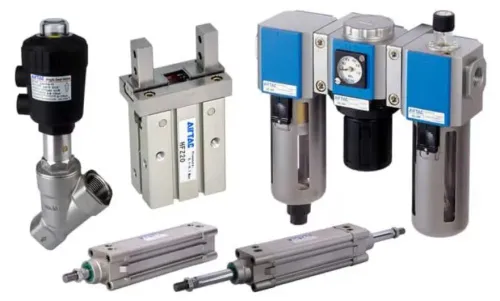
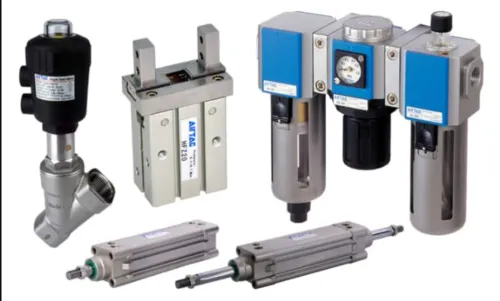
 | Pneumatic Component Set Pneumatic Automation Combo – Gripper, Cylinders, FRL, Angle Seat Valve This curated pneumatic combo set brings together essential components for industrial automation. View product → |
Frequently asked questions
What must you confirm before ordering fittings for an HFZ20 gripper?
Identify the exact HFZ20 model and check its datasheet for thread standard, thread size, port location, pressure range, and permitted tube outside diameter.
How do you choose pneumatic gripper fittings that fit the installation space?
Match the fitting thread and tube size to the gripper, then choose a straight, elbow, or compact fitting that clears the jaws, tooling, and moving parts.
What is the correct connection order for a gripper circuit?
Route compressed air through the FRL, into the five-port directional valve, and then connect the valve’s working ports to the gripper ports using correctly sized tubing and fittings.
What should you include in a purchasing specification for gripper air connections?
State the HFZ20 model, thread standard and size, port orientation, tube outside diameter, fitting shape, pressure range, materials, quantity, and plant-air requirements.
Keywords