Pneumatic fittings are small components with an important role in compressed-air systems. They connect tubes, hoses, valves, cylinders, and other pneumatic equipment so that compressed air can move efficiently through the system.
For manufacturing units and industrial facilities in Bangalore, particularly around Peenya and other industrial areas, choosing the correct fitting is important for maintaining reliable airflow and reducing leakage. A fitting that does not match the tube size, thread type, pressure requirement, or operating environment can affect the performance of the entire pneumatic circuit.
What Are Pneumatic Fittings?
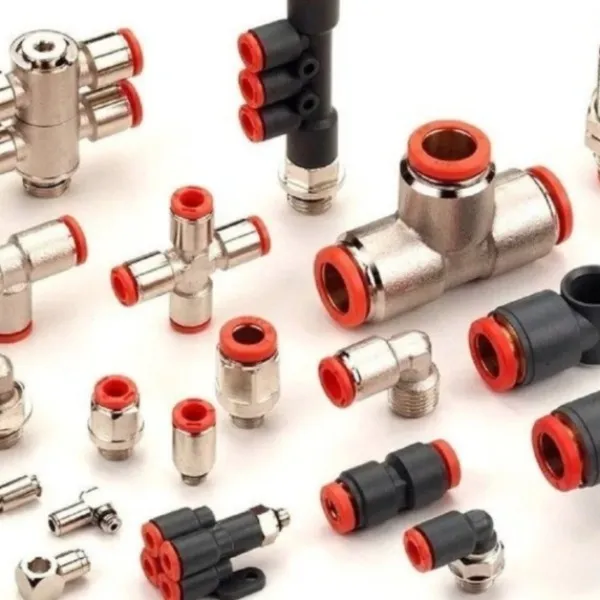
Pneumatic fittings are connectors designed specifically for compressed-air and pneumatic applications. They are commonly installed between pneumatic tubing and components such as air cylinders, solenoid valves, control valves, filters, regulators, and manifolds.
Modern industrial systems frequently use push-to-connect fittings because they make installation and maintenance relatively straightforward. The tube is inserted into the fitting and secured by an internal gripping mechanism.
Other designs may use threaded, compression, or barbed connections depending on the application.
Common Types of Pneumatic Fittings
Different layouts require different fitting configurations. Frequently used options include:
- Straight connectors: Join tubing in a straight line or connect tubing to threaded equipment.
- Elbow fittings: Change airflow direction, generally at a 90-degree angle.
- Tee fittings: Divide one pneumatic line into two branches.
- Union fittings: Connect two sections of pneumatic tubing.
- Reducers: Connect tubes or ports of different sizes.
- Bulkhead fittings: Allow tubing connections through machine panels or enclosures.
- Flow-control fittings: Combine the connection point with airflow adjustment.
Selecting the right configuration can make pneumatic piping more compact and easier to maintain.
Why Fitting Selection Matters in Bangalore Industrial Applications
Industrial environments in Bangalore, Karnataka, can involve continuous production cycles, automated machinery, packaging equipment, CNC systems, assembly stations, and material-handling equipment.
In these applications, poorly selected air fittings may contribute to leakage, pressure loss, unstable actuator operation, or unnecessary compressor workload.
The fitting should therefore be evaluated according to:
- Tube outside diameter
- Port and thread dimensions
- Working pressure
- Operating temperature
- Fitting material
- Fluid compatibility
- Installation space
- Frequency of maintenance
Hakimi Pneumatic & Hardware supports industrial requirements involving pneumatic fittings and related components used across different machinery and compressed-air applications.
Pneumatic Fittings and PU Tubing
PU pipe or polyurethane pneumatic tubing is widely used because it is flexible, lightweight, and convenient for routing through machinery.
However, tubing and fittings must be properly matched. Using an incorrect tube diameter can prevent the fitting from sealing correctly. Tubing should also be cut cleanly and squarely before insertion.
A damaged or angled tube end can increase the possibility of air leakage even when the fitting itself is suitable.
Basic Installation Practices
Reliable installation starts with simple precautions.
Always inspect the tube for cuts, scratches, deformation, or contamination. Insert it fully into a push fitting and check that it is securely retained.
For threaded fittings, use an appropriate sealing method without allowing sealing material to enter the airflow passage.
Once installation is complete, the system should be checked for leakage under normal operating pressure.
Understanding these basics helps manufacturers and maintenance teams build pneumatic systems that are easier to operate, inspect, and maintain over the long term.
Keywords