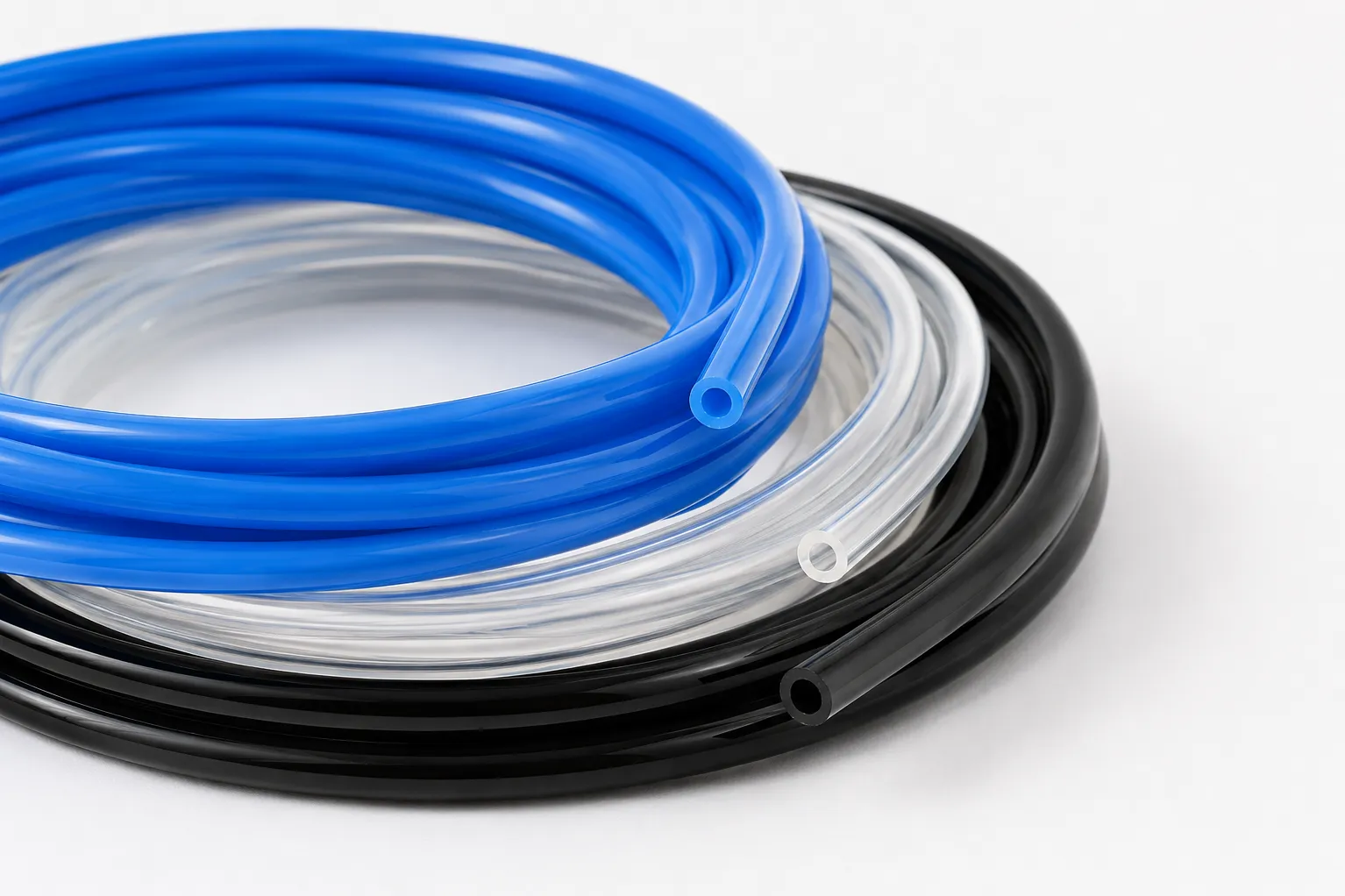
Pneumatic tubing carries compressed air throughout an automated machine. Although selecting tubing may appear straightforward, choosing only by diameter can create performance problems.
Material, airflow requirement, pressure, temperature, flexibility, bend radius, environmental exposure, and fitting compatibility all need consideration.
For industrial users in Bangalore, evaluating these factors before purchasing pneumatic tubing can help prevent avoidable modifications during machine installation.
Start With Tube Size
Pneumatic tubing is commonly selected according to its outside diameter because push-in connectors are designed around specific tube dimensions.
The tube and fitting must match accurately.
An incorrect size can lead to:
- Poor sealing
- Difficult installation
- Tube disconnection
- Air leakage
- Reduced system reliability
Tube size also influences airflow. Long pneumatic runs or actuators requiring higher airflow may need larger tubing than short, low-flow control circuits.
Consider the Required Flexibility
Machine layouts often require air lines to travel around frames, electrical panels, actuators, guards, and other equipment.
Flexible tubing such as PU pipe is commonly selected where easy routing is important.
However, excessive bending should be avoided. A very tight bend can partially collapse or kink the tube, restricting airflow.
Choosing Pneumatic Tubing for Dabaspet Manufacturing Applications
Industrial operations around Dabaspet and the wider Bangalore region include engineering, fabrication, processing, automotive-related manufacturing, and other production activities.
Different machines can place very different demands on pneumatic tubing.
Before selecting tubing, evaluate:
- Working pressure
- Operating temperature
- Required airflow
- Tube length
- Bend requirements
- Movement or flexing
- Exposure to oils or chemicals
- Abrasion risk
- Compatible pneumatic fittings
Hakimi Pneumatic & Hardware supplies pneumatic products for industrial applications where tubing must integrate correctly with fittings, valves, cylinders, and other compressed-air components.
Don't Ignore the Working Environment
A tube that performs well inside a protected automation panel may not necessarily be the best choice near heat sources, sharp metal edges, chemicals, or moving machinery.
Inspect the intended installation area before finalising tubing.
Where abrasion is possible, routing should minimise contact with rough surfaces. Where machinery moves repeatedly, sufficient allowance should be provided so that tubing is not continuously stretched.
Check Compatibility With Pneumatic Connectors
Tubing and connectors function as a system.
Even correctly sized tubing can create problems if its material, dimensional tolerance, or surface condition is unsuitable for the connector.
When using push-to-connect fittings, the tube end should be:
- Clean
- Round
- Undamaged
- Cut squarely
- Inserted completely
Using a proper tube cutter can produce a cleaner connection than cutting pneumatic tubing with unsuitable tools.
Avoid Choosing Tubing Only by Price
The lowest initial tubing cost does not necessarily provide the lowest operating cost.
Repeated leakage, premature replacement, restricted airflow, and maintenance interruptions can cost significantly more than the difference between suitable and unsuitable tubing.
A better buying approach is to evaluate the complete application.
Correct pneumatic tubing should provide the necessary airflow, fit securely with the selected connectors, tolerate the working environment, and remain practical to route and maintain throughout the machine's operating life.
Keywords